Lab #10: Urban Applications in Remote Sensing
(Due on 4/20/2004)
(Note: please use separate sheets to type up your answers)
Objectives
·
To understand
and identify remote sensing urban environment resolution considerations and
develop land use criteria.
·
To identify
urban features and develop simple criteria for their identification.
The use of remotely sensed imagery is becoming common place for all levels of
government for city, county, and state planning; change detection and
monitoring; and construction planning and zoning. Examples of urban
applications include road and rail transportation, telecommunications, and
utility networks. These can be monitored, updated, and planned as required.
Changes and updates can be made to population, tax assessment, commercial, and
residential zoning data and base maps.
Resolution Considerations
1)
Discuss the
three types of temporal resolutions that are considered when monitoring urban
environments.
2) What is the minimum resolution required for
extracting most urban information and what is the general rule in terms of
spatial resolution to identify urban objects?
3) Define the difference between land cover and
land use and discuss spatial resolution requirements and appropriate sensors
for use in determining the four levels of the USGS land use/land cover
classification system.
4) Residential development often progresses
through identifiable stages. The table below contains six images showing the
developmental stages of single-family residential housing. For each stage,
describe the criteria using identifiable features within the image that set it
apart from the other developmental stages.


Urban Classification Criteria
5)
The following images
depict various urban features (click to enlarge). Identify the features and develop some simple criteria for their
identification.


6) Complete the table below by matching
applications to their supporting remote sensing data.
|
Spatial
Resolution |
Temporal
Resolution |
Sensor |
Application Area |
|
.05 meter |
|
|
Parking Studies |
|
|
12 hour |
|
Traffic Count |
|
|
|
IKONOS |
Damage Transportation |
|
|
|
|
USGS Level IV |
|
5 meter |
|
|
Population Estimates |
|
|
|
|
Utility Line Routing |
|
|
|
|
DEM Creation |
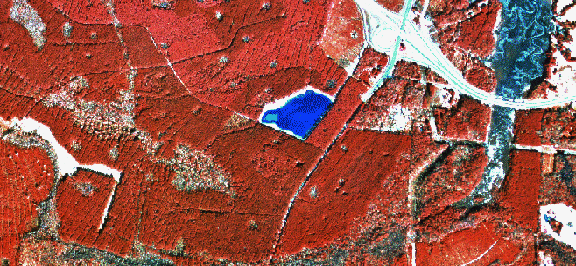
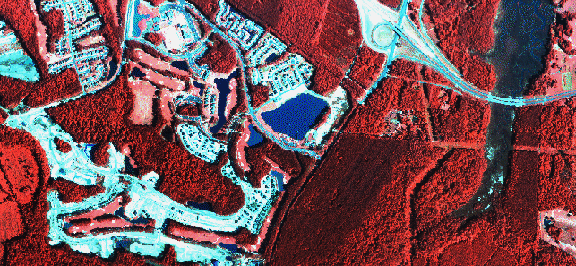
7) The following images are taken 21 months apart
and represent an excellent example of how remote sensing can be used to detect
urban change. Analyze each of the images and discuss how planners and
environmentalists can benefit from the detection of urban growth in
environmental sensitive areas.
Sun City Hilton Head near Beaufort, SC
NAPP data acquired January
22, 1994 RGB = 3,2,1
|
CAMS data acquired
September 21, 1996 RGB = 6,4,2
|

8) The Census Bureau has hired you to conduct
population estimations on a local and regional scale using remote sensing techniques.
What procedures would you use to estimate populations for the city of Denton
and the state of Texas?